


HowleyUSA exclusively uses American-made Polartec fleece in all its hats.
As a young man, Carl Caruso spent much of his free time behind the wheel of a 1966 Dodge van, crisscrossing the Northeast from city to city to catch Grateful Dead concerts.
On one of those trips, Caruso stopped at a country store in Vermont and bought a winter hat. It was a simple purchase, but the hat stayed with him for decades, eventually becoming much more than a souvenir from his Grateful Dead days.
What Caruso didn’t realize was that his new beanie came from the first wave of Polartec fleece introduced to the American textile market. He just knew it was warm, comfortable and built to last.
Nearly 40 years later, after an extensive career as a mechanical engineer at Johnson & Johnson, that old hat helped inspire his next chapter.
“I bought this hat 40 years ago,” Caruso said. “It was made out of Polartec. It was when synthetic fleece showed up on the market. It was like space age. I am still convinced it is the best hat in the world.”
Eventually, admiration became inspiration.
In 2023, Caruso officially launched HowleyUSA, a small manufacturing company operating out of a barn on his property in Flemington, N.J.. Its flagship Original Howley traces its design directly to that vintage fleece cap.
Now the same commitment to domestic production that shaped Caruso’s second career has earned HowleyUSA a place in the Alliance for American Manufacturing’s 13th annual Made in America Holiday Gift Guide, which will be released Tuesday, Nov. 24. The annual guide highlights American-made products and the companies and workers who make them.
For Caruso, though, the story still comes back to that old hat.
“We pretty much replicated this hat with the exception that we had to build out five sizes from small to extra-large,” Caruso said. “It’s a direct replica of these 1980s vintage Polartec fleece hats that they were making back then. It’s American made.”
Recreating a favorite was one thing. Turning it into a product that could comfortably fit a wide range of customers was another.
Unlike many stretchy knit caps, the Original Howley is constructed more like apparel, with pieces of fleece cut from patterns and sewn together. Caruso discovered the limitations of one-size-fits-all when his wife tried on his prized original.
“I put that hat on my wife and it went down to her eyes,” Caruso said. “It has stretch, but it’s not like a rubber band like a woven hat.”
HowleyUSA developed five sizes, from extra small through extra-large, aiming for warmth without the tight squeeze common to many winter caps.
“You want that really gentle touch,” Caruso said. “Super soft material and a really light, gentle touch. You can go inside and not even remember you are still wearing the hat.”
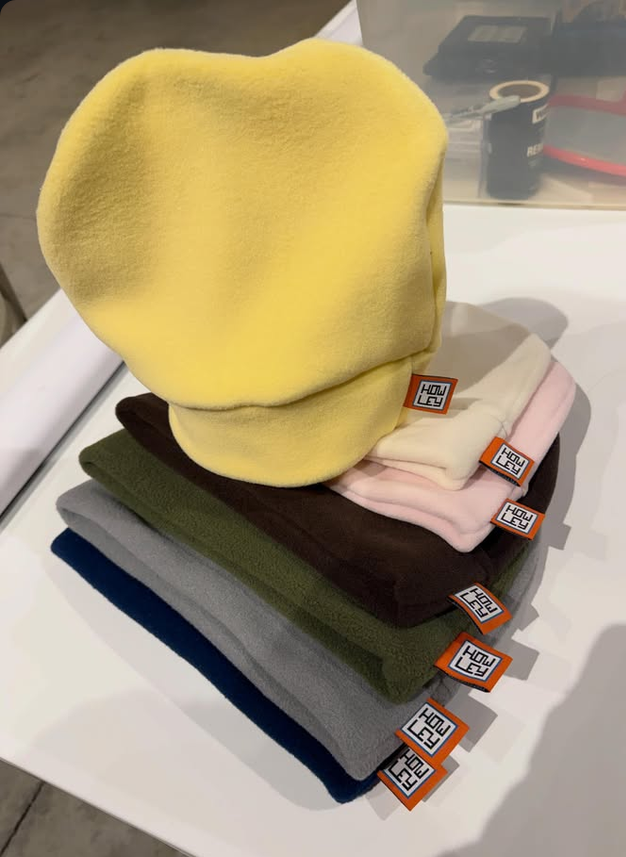
What started with one old hat has grown into a line of six styles.
The Original remains the bestseller. The House Hat uses Polartec Power Wool, combining Merino wool and synthetic fibers. HowleyUSA also makes lower-profile styles, liners designed to fit beneath baseball caps or helmets, and brimmed winter hats.
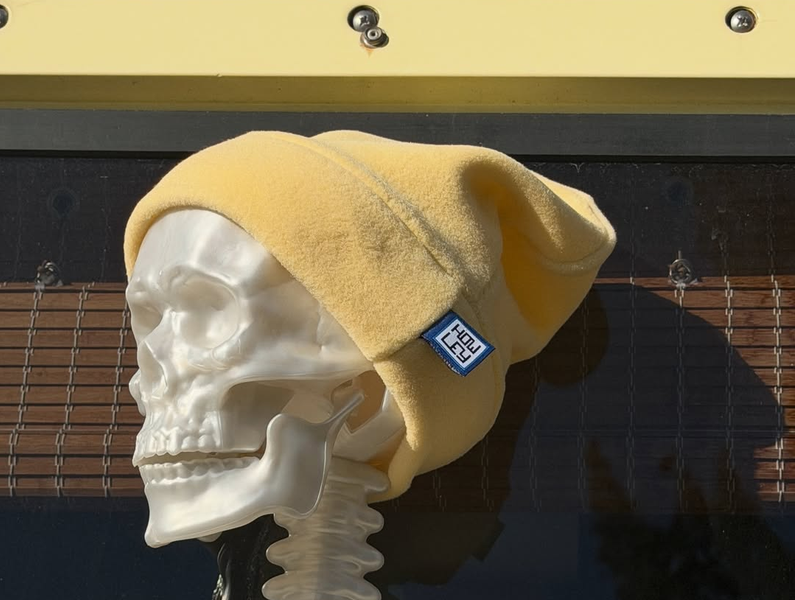
Those brimmed hats have given Caruso room to experiment. Their fleece construction allows wearers to manipulate the crown into different shapes. The fleece provides lightweight warmth by trapping body heat in microscopic air pockets rather than relying on heavy material.
“You can learn how to get your favorite thing shaped in there, and they hold,” Caruso said. “You can have a lot of fun shaping it into the hat you want, including a top hat.”
Caruso earned an engineering degree from Lehigh University and spent much of his career at Johnson & Johnson, working in engineering, manufacturing, operations and supply chains. He began by designing and building high-speed machinery before assuming broader responsibilities.
His career also gave him a front-row seat to one of the defining changes in American manufacturing: the movement of production overseas.
“I came out of manufacturing,” Caruso said. “I ran operations, so I would see the cost sheet. I would see the cost of labor per part.”
Sometimes the calculations on those spreadsheets carried consequences far beyond the balance sheet.
Caruso recalls being responsible for moving one operation from Sherman, Texas, to China. The Texas facility had old automated machinery that had been producing goods for decades. The equipment, he said, continued to run and make money, but lower overseas labor costs offered another option.
The experience helped shape Caruso’s view of trade and domestic manufacturing.
“NAFTA was the moment that trade put profit over people,” Caruso said.
Years later, when he began considering a manufacturing business of his own, Caruso understood exactly how difficult it could be for an American-made product to compete with goods produced in lower-wage countries.
Hats, however, offered an opening.
Their relatively straightforward cut-and-sew construction kept labor requirements manageable, and getting into production didn’t require the enormous capital investment associated with some industrial manufacturing. Caruso estimates that a single injection mold in his former world could cost $100,000.
“We make hats with a lot of love, precision, quality control, and in the end we can do all of that and be fairly competitive,” Caruso said.
Today, HowleyUSA hats are cut and sewn in the barn on Caruso’s New Jersey property. The small workforce expands and contracts with demand and the calendar drives much of that demand.
“We are so seasonal,” Caruso said. “We are all about Christmas.”
HowleyUSA has worked its way into ski shops and local boutiques through a town-by-town retail strategy while putting greater emphasis on online sales. Caruso has built the manufacturing operation with room to expand and has set a goal of selling 5,000 hats this year.
More sales would mean more production, but Caruso says growth won’t alter a fundamental decision he made when starting HowleyUSA.
The company obtains Polartec fabrics through Mill Direct Textiles in New Hampshire, giving a manufacturer of its size access to material by the roll.
“All of my hats use Polartec from American mills only,” Caruso said. “That’s my decision.”
HowleyUSA also uses some second-quality Polartec material. A defect can cause rolled fabric to be classified as second quality, but the company’s small-scale manufacturing provides an advantage. Because its hats are individually cut, the team can identify an imperfection and work around it rather than discard otherwise usable material.
It’s the sort of efficiency that appeals to an engineer.
So does Caruso’s enduring fascination with the fleece itself.
Four decades after first encountering Polartec, he remembers how revolutionary the lightweight synthetic fabric seemed compared with the bulkier cold-weather clothing of the time. Ironically, that lightness can present a challenge when selling the hats. A customer picking one up for the first time might instinctively equate heavier material with greater warmth.
Caruso says that misses the point.
“You get twice the warmth with half the weight,” he said. “It keeps you super toasty.”

But perhaps the biggest surprise awaiting the veteran manufacturing executive had nothing to do with fabric, engineering or factory production.
Caruso knew how to make things. He understood production, supply chains, capacity, costs and quality control. After years spent developing the hats and preparing the operation, he switched on the HowleyUSA website expecting those skills to translate naturally into sales.
They didn’t.
“I got everything set up to make and sell the hats,” Caruso said. “I got the website turned on and thought customers were going to start pouring in. But no, I didn’t understand sales and marketing for all of this.”
He can laugh about that assumption now.
“So, we’ve been chugging away and having fun,” Caruso said. “The business is growing and once people feel the smooth Polartec fabric, they are impressed.”
But HowleyUSA is about more than building a business.
HowleyUSA is too young and small to consider union representation for its employees but Caruso is no stranger to the world of organizing. Caruso’s father and grandfather were union members, and Caruso worked as a union apprentice electrician before beginning his engineering career. He describes himself as “super pro-union.”
After decades spent watching the economics of global manufacturing play out from inside the industry, Caruso now gets to make his own decisions about labor, materials and where his products are made.
“Yes, we are making our hats in America with American workers,” Caruso said. “I’ve seen the other side of manufacturing, using cheap overseas labor and it is not pretty.
“I am asking for fair trade. No exceptions.”
The Alliance for American Manufacturing does not receive a commission from purchases made through the above links, nor was the organization or author paid for favorable coverage.
Labeling Note: This story is intended to highlight companies that support American jobs and that make great products in the United States. We rely on the companies listed to provide accurate information regarding their domestic operations and their products. Each company featured is individually responsible for labeling and advertising their products according to applicable standards, such as the Federal Trade Commission’s “Made in USA” standard or California’s “Made in USA” labeling law. We do not review individual products for compliance or claim that because a company is listed in the guide that their products comply with specific labeling or advertising standards. Our focus is on supporting companies that create American jobs.
For more on the Federal Trade Commission’s standards for “Made in USA” claims and California’s “Made in USA” labeling law, please also read this guest post by Dustin Painter and Kristi Wolff of Kelly Drye & Warren, LLP.